Prop Trading or Your Own Money? How to Choose the Route That Fits You
Full guide · 15 min read · last fact-check 2026-07-25
How to choose the route that fits your capital, strategy, personality, and experience
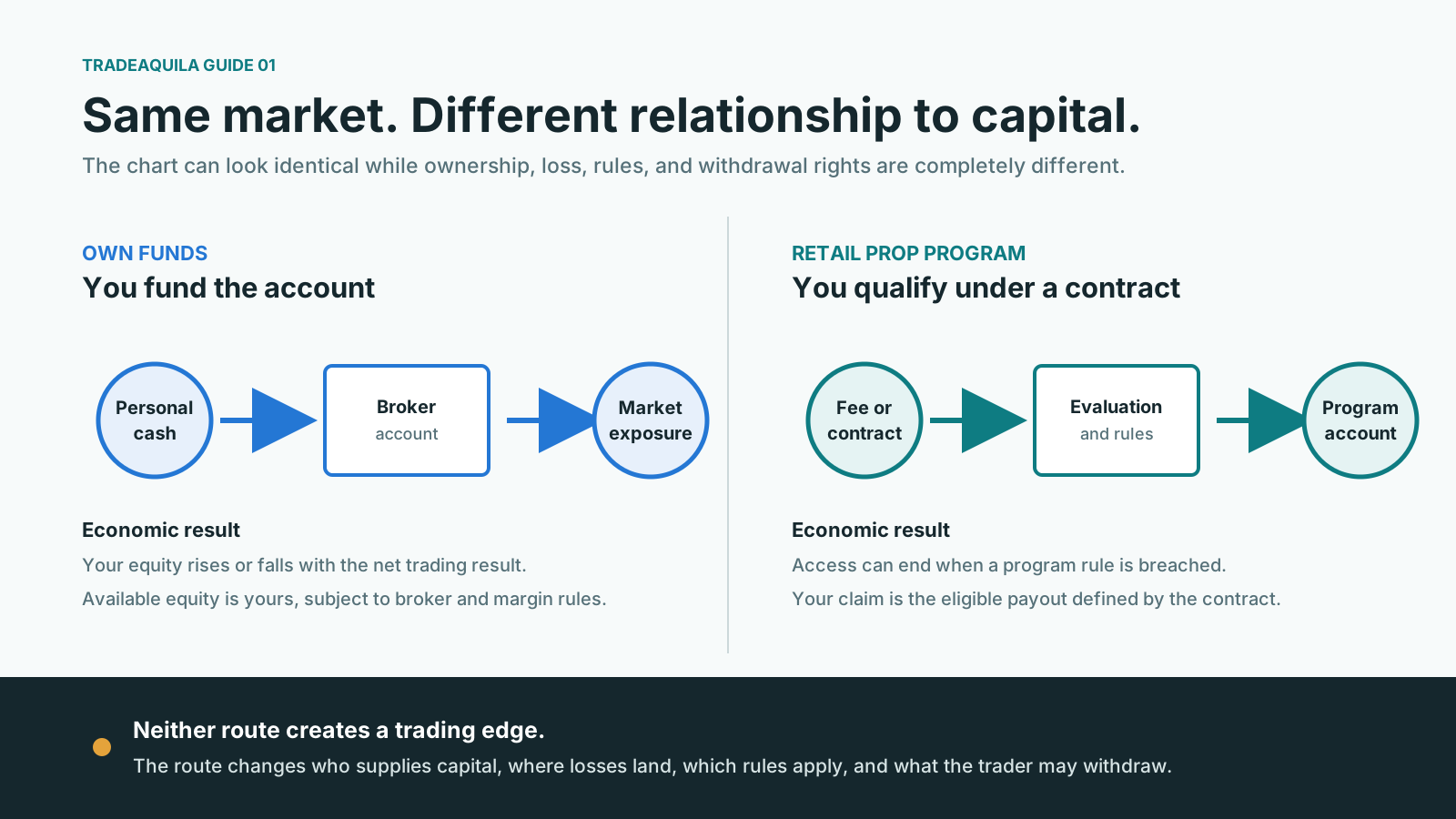
Two traders can open the same chart, trade the same instrument, and take the same position while operating under completely different economic realities.
One may be trading money deposited with a broker. Every gain and loss changes that trader's own account balance.
The other may be trading through a proprietary trading program. The displayed account can be much larger, but the trader may be operating inside a simulated environment, a fixed drawdown allowance, detailed program rules, and a contractual payout arrangement.
Neither route is universally superior.
The useful question is not:
Is prop trading better than trading my own money?
It is:
Which route allows my strategy and behavior to function without exposing me to risks or constraints I do not understand?
This guide explains the differences without recommending a provider or assuming that every trader should choose one of the two routes immediately.
Short answer: A prop program can reduce the amount of personal cash initially exposed, but it replaces capital freedom with program rules, qualification costs, and reliance on the provider. Trading your own funds gives you more control and a direct claim on your account balance, but your real money absorbs the losses. A trader without a tested process may not yet be ready for either route.
1. First, understand what "prop trading" can mean
The expression prop trading is used for several different arrangements. This causes a great deal of confusion, particularly for beginners.
Traditional proprietary trading
A traditional proprietary trading firm trades its own capital in live markets. Its traders may be employees, contractors, or members operating under the firm's infrastructure and risk controls.
The firm owns the capital and normally carries the market risk. The trader is compensated according to an employment, bonus, or profit-sharing agreement. Selection can involve interviews, professional experience, training, and internal risk approval.
Retail evaluation or funded-trader programs
Many online programs sell access to an evaluation. The trader attempts to meet a profit objective while staying inside limits such as:
- Maximum daily loss
- Maximum total or trailing drawdown
- Position-size limits
- Minimum trading days
- Consistency requirements
- News, overnight, or weekend restrictions
- Prohibited strategy or execution practices
Passing can lead to a second evaluation, a simulated "funded" stage, a live-funded stage, or another contractual arrangement. The meaning of funded is therefore provider-specific.
For example, FTMO states that all accounts it provides to clients use fictitious capital in a simulated environment, with real financial rewards calculated from the simulated results. Topstep describes its Trading Combine as simulated, followed by an Express Funded Account used to build a payout record, with a Live Funded Account as a later destination. These examples show why the account label alone is not enough. Read the provider's current contract and program documentation. FTMO account explanation, Topstep program overview
A real payout does not necessarily mean that the trades themselves were sent to a live market. Equally, a simulated stage does not mean that a provider can never use a trader's data or move a trader to live capital. The contract should explain the relationship.
Trading your own funds
When trading your own funds, you deposit your money with a broker and trade from that account.
Your net profits increase your equity. Your losses reduce it. You normally choose the broker, account type, position size, and withdrawal timing, subject to the broker's terms, margin rules, the instruments being traded, and the law in your jurisdiction.
This route still involves external parties and rules. A broker controls access to the market or dealing platform. Client-money treatment, insolvency protection, execution, leverage, and negative-balance protection vary by product and jurisdiction.
2. The practical difference in one table
| Question | Retail prop program | Own-funds broker account |
|---|---|---|
| What do you provide first? | Usually an evaluation fee, subscription, activation cost, or qualification effort | A cash deposit belonging to you |
| Whose balance is displayed? | Often a notional or simulated program balance; structures vary | Your funded account equity |
| What normally ends the account? | A rule breach, contract termination, or failure to meet the program conditions | Depletion of equity, a margin event, broker closure, or your decision to stop |
| Who absorbs trading losses? | Depends on the stage; in a simulated program, the provider may terminate access while the trader loses fees rather than the displayed balance | The trader's own account absorbs the loss |
| What can the trader withdraw? | A contractual reward or profit share after satisfying payout conditions | Available account equity, subject to broker, settlement, margin, and withdrawal rules |
| Who defines the risk limits? | The provider, although the trader can impose tighter personal limits | Primarily the trader, plus broker and market margin requirements |
| How much strategy freedom exists? | Only what the program contract allows | Usually broader, subject to broker, market, and legal restrictions |
| What are the recurring costs? | Evaluation, reset, subscription, activation, data, platform, commission, spread, and the provider's share can all matter | Spread, commission, financing, exchange, data, platform, slippage, and tax can matter |
| What is the main dependency? | The provider's rules, technology, payout process, and continued operation | The broker's execution, custody or client-money arrangements, withdrawals, and continued operation |
| What is the main behavioral challenge? | Operating under hard external limits and targets | Protecting real personal capital without external program guardrails |
This table describes common structures, not every structure. A live proprietary allocation can look different from a simulated retail program, and an exchange-traded futures account can look different from an OTC CFD account.
3. The most important beginner concept: displayed balance is not risk budget
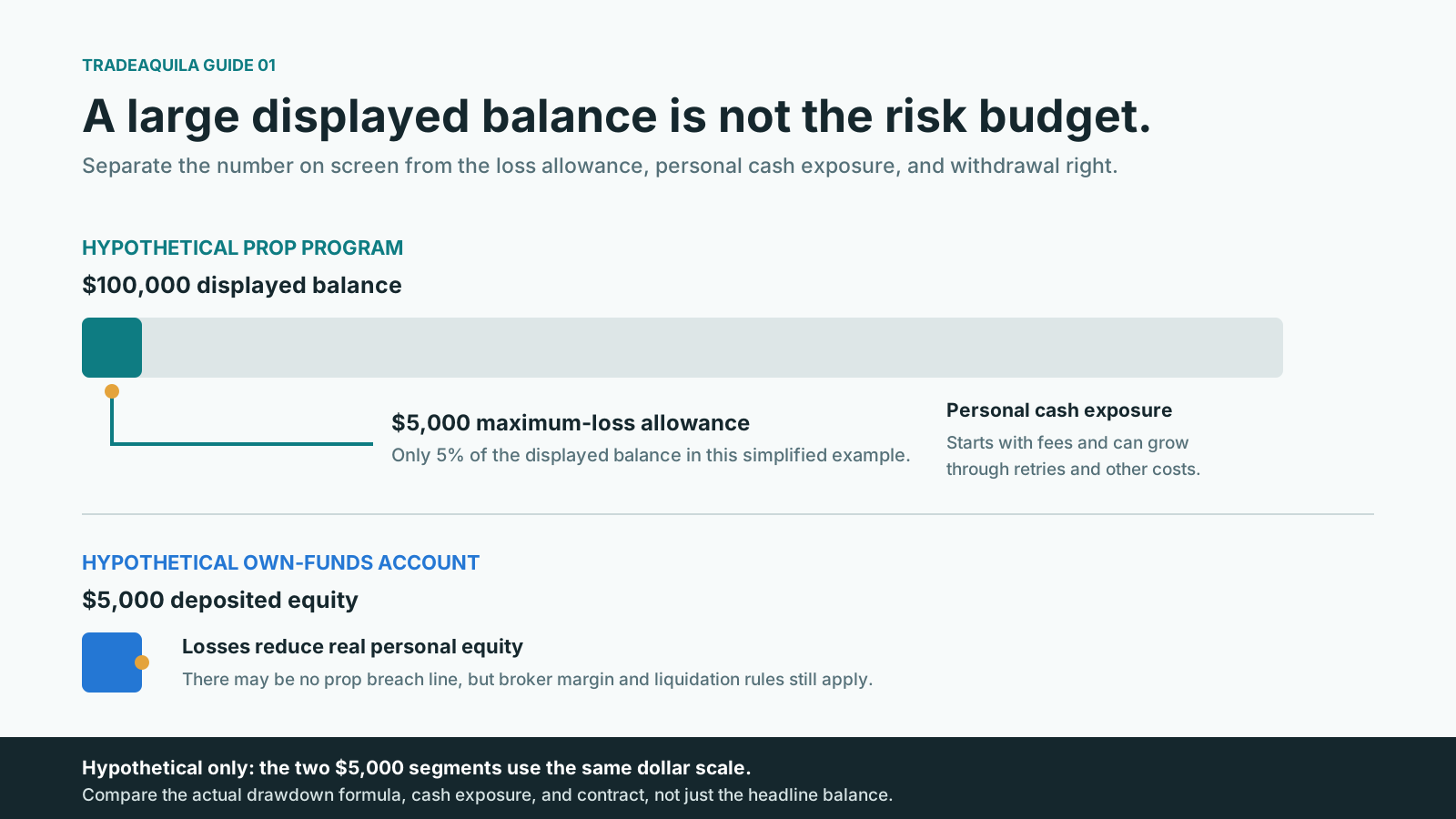
A large number at the top of a trading platform can create a false sense of capital.
Four amounts must be separated:
- Displayed balance: the number shown on the account.
- Loss allowance: the decline permitted before a program or margin rule is triggered.
- Personal cash at risk: money the trader can actually lose, including fees, resets, and deposited capital.
- Economic claim: what the trader is contractually entitled to withdraw.
A hypothetical prop example
Suppose a program displays a $100,000 account and has:
- A
$5,000maximum-loss limit - A
$2,000daily-loss limit - A
$300evaluation fee - A contractual share of eligible simulated profit
The trader does not own $100,000. The number most relevant to strategy
survival is the drawdown allowance and exactly how it is calculated.
The trader's immediate personal cash exposure may begin with the $300 fee,
but repeated evaluations, resets, subscriptions, or activation costs can make
the total larger. The trader's economic claim is the payout defined in the
contract, not the displayed balance.
A hypothetical own-funds example
Suppose a trader deposits $5,000 with a broker.
There may be no external profit target and no prop-program breach line, but losses reduce real account equity. Leverage can create market exposure far greater than the deposit, and a broker may close positions when margin falls below its requirement.
For retail OTC forex, the CFTC warns that leverage amplifies gains and losses, the dealer is the customer's counterparty, and protections depend on the dealer and jurisdiction. For retail CFDs in the United Kingdom, the FCA requires leverage limits, margin close-out, negative-balance protection, and standardized loss warnings, but those protections may not apply when a client uses an offshore firm or is classified differently. CFTC forex advisory, FCA CFD information
The lesson is not that the two examples are equivalent. It is that account size should never be compared without also comparing:
- Actual loss boundary
- Personal cash exposure
- Position and leverage rules
- Payout or withdrawal rights
- Counterparty risk
4. When a prop route may fit
A prop route may be worth investigating when several of the following are true.
Your strategy already has evidence behind it
You have enough trades to estimate:
- Typical and worst observed drawdown
- Losing-streak length
- Intraday loss distribution
- Average holding period
- Sensitivity to spread, commission, and slippage
The evaluation should test an existing process. It should not be used to discover whether a strategy works while a fee and profit target are creating pressure.
Your strategy fits the rules without distortion
The program's daily and maximum-loss calculations leave room for the strategy's normal variation. You do not have to triple your usual risk, force extra trades, or abandon valid exits simply to reach the target.
You have limited trading capital but can afford the total program cost
The fee may represent less immediate personal exposure than funding a larger broker account. That can be economically useful, but only if the cost of failed attempts, resets, subscriptions, and activation remains affordable.
Money required for rent, debt, emergencies, education, or basic living costs does not become risk capital merely because it is being spent on an evaluation rather than deposited with a broker.
External limits improve your execution
Some traders perform better when a daily stop and maximum-loss boundary are non-negotiable.
This is helpful only when the rules support the strategy. A rule can stop a bad day, but it cannot create an edge or repair an impulsive decision process.
You accept provider and contract risk
You understand:
- Whether each stage is simulated or live
- How payouts are calculated and reviewed
- What behavior is prohibited
- Whether rules can change
- What happens during outages and price disputes
- Which legal entity owes the payout
- What rights exist if the provider fails
5. When trading your own funds may fit
An own-funds route may be worth investigating when several different conditions are true.
You have disposable risk capital
The deposit is money you can lose without compromising financial security. This does not mean you expect to lose it. It means a loss would not create an emergency.
FINRA's day-trading disclosure warns against using retirement savings, student loans, emergency funds, home-related funds, or money required for living expenses. The warning is written for securities day trading, but the underlying financial principle is broadly useful. FINRA day-trading risk disclosure
Your strategy needs autonomy
Your process may require:
- Holding through scheduled news
- Overnight or weekend positions
- Wide stops and infrequent trades
- Multiple correlated positions
- Partial hedging
- Gradual compounding
- A platform, order type, or instrument unavailable in a program
An own-funds account can offer more freedom, although the broker and market still impose margin, execution, and product rules.
You want direct control over withdrawals and compounding
Eligible equity belongs to the account holder, subject to open positions, settlement, margin, the broker's withdrawal process, and local law. There is no program profit target or performance-reward contract.
You can enforce your own limits
Freedom is useful only when the trader can define and respect:
- Maximum risk per trade
- Daily and weekly stop levels
- Aggregate exposure
- Maximum drawdown
- Conditions for reducing or pausing trading
Without those controls, autonomy can become unlimited permission to continue losing.
6. Personality can change the answer
The same rule can help one trader and harm another.
| Behavioral tendency | Possible effect in a prop program | Possible effect with own funds | Question to ask |
|---|---|---|---|
| Performs well under firm boundaries | Hard limits can simplify decisions | Self-imposed rules may feel negotiable | Do external limits improve consistency or merely postpone a breach? |
| Becomes fixated on targets | Profit targets can cause forced trades and oversized risk | No evaluation target, but personal income goals can create the same pressure | Does a target change trades that your strategy would otherwise take? |
| Fears losing personal money | A fee may feel easier to tolerate than a large deposit | Real-time equity changes may cause hesitation and early exits | Does the route preserve valid execution or distort it? |
| Treats simulated money casually | A large notional balance can encourage over-sizing | Real capital may produce more caution | Do you size from tested risk or from the number displayed? |
| Revenge trades after a loss | A breach can end the session or account quickly | More equity may remain available for further impulsive trades | What mechanism stops the second bad decision? |
| Repeatedly buys new attempts | Reset availability can turn failure into a recurring purchase loop | Depositing more can create a similar loop | Is there a fixed monthly and annual loss budget? |
| Needs full autonomy | Third-party rules may feel intrusive | Freedom can support the strategy | Can you exercise autonomy without abandoning risk limits? |
Neither structure automatically creates discipline. It changes where discipline is tested.
7. Trading style is a hard constraint, not a preference
Before comparing brands or account prices, compare the route with the actual strategy.
Intraday and scalping strategies
Check:
- Daily-loss calculation and reset time
- Spread, commission, and slippage
- Minimum stop distance and order restrictions
- News restrictions
- Maximum position size
- Latency and platform stability
A strategy with many small trades can be especially sensitive to transaction costs and execution differences.
Swing and position strategies
Check:
- Overnight and weekend holding
- Financing and rollover
- Gap treatment
- Trailing drawdown while positions are open
- Contract expiration or swap behavior
- Whether open profit affects the loss limit
A program can advertise a generous maximum drawdown while still being incompatible with a strategy that experiences normal open-position fluctuation.
News trading
Check the exact rule before, during, and after scheduled events. Some programs allow news trading, some restrict opening or closing trades within a window, and some apply different rules by stage or account type.
Automated strategies and EAs
Check:
- Whether automation is permitted
- Platform and API support
- VPS requirements
- Copy-trading and multi-account rules
- Identical-strategy restrictions
- Maximum message or order frequency
- Behavior during disconnection
- Who can disable or flatten positions
An EA that is profitable in a broker backtest may still be operationally incompatible with a program's execution and risk rules.
Futures strategies
Do not confuse a futures contract's notional value with the cash required to hold it. Initial and maintenance margin can change, and brokers can require more than the exchange minimum. CME explains that a relatively small futures margin can control a much larger contract value, making small price movements produce large gains or losses relative to the deposited margin. CME futures margin guide
8. Five traders, five different conclusions
These examples are fictional. They illustrate the decision process rather than recommend a product.
Maya: the motivated beginner
Maya has traded for six weeks. She has changed strategy three times and does not know her normal losing streak or drawdown.
Likely conclusion: Neither route should be rushed. A demo environment and a small, documented learning process can answer questions that an evaluation fee or leveraged deposit cannot.
The problem is not access to capital. It is the absence of a stable process.
Omar: the consistent intraday trader with limited capital
Omar has twelve months of records. His strategy closes all positions before the session ends, trades infrequently, and has historically stayed well inside the program rules he is studying.
Possible conclusion: A carefully selected prop program may be a reasonable route to test, provided the full fee scenario is affordable and the contract and payout conditions are acceptable.
The potential fit comes from strategy compatibility and evidence, not from the headline account size.
Lina: the low-frequency swing trader
Lina may hold trades for several days, including through overnight sessions and selected news events. Her positions need room for normal open drawdown.
Possible conclusion: An own-funds account may preserve her strategy better than a program with trailing drawdown, news restrictions, or weekend rules. A compatible prop account could still exist, but the rule fit must be proven before price is compared.
Daniel: the EA operator
Daniel has an MT5 system that depends on continuous VPS operation, multiple small entries, and a specific broker symbol configuration.
Possible conclusion: Either route could work. His decision depends on automation permission, symbol mapping, commissions, latency, order-frequency rules, and what happens during disconnections. The operational environment is as important as the account economics.
Sara: the trader using essential savings
Sara has a strategy she believes in, but the only available money is her emergency fund. She is considering a broker deposit or repeated evaluation purchases.
Likely conclusion: Neither is appropriate for that money. Changing the form of the expenditure does not change its importance to her financial security.
9. Compare twelve-month economics, not the first payment
The first visible price can be misleading.
Possible prop-program costs
- Initial evaluation or subscription
- Resets and repeat attempts
- Activation
- Market data
- Platform fees
- Spread and commission
- Withdrawal or conversion costs
- The provider's share of eligible performance
- Time spent qualifying instead of operating the final account
Possible own-funds costs
- Spread and commission
- Exchange and regulatory fees
- Financing or swap
- Market data and platform costs
- Slippage
- Currency conversion
- Tax and accounting
- The opportunity cost of keeping capital in the account
A broker deposit is not itself a fee because the remaining equity still belongs to the trader. It is, however, capital at risk.
A prop fee can be smaller than a broker deposit, but it purchases a conditional service rather than equity in the displayed account.
Likewise, comparing a 90% performance reward with keeping 100% of broker
profits is incomplete. The capital source, loss boundary, fees, strategy
constraints, and probability of reaching an eligible payout are different.
Build at least three scenarios:
- Expected case: normal performance and normal operating costs.
- Difficult case: several failed attempts or a substantial broker drawdown.
- Operational failure case: outage, rule misunderstanding, withdrawal dispute, or provider/broker failure.
The purpose is not to predict the future precisely. It is to reveal where each route concentrates risk.
10. A neutral six-step decision process
Step 1: Verify the strategy before choosing the capital route
Use a meaningful sample of trades and include realistic costs. Separate backtest, demo, and live evidence. A strategy can look stable in one environment and fail in another.
Step 2: Measure the strategy's risk behavior
Document:
- Maximum intraday and total drawdown
- Losing-streak distribution
- Worst trade and worst day
- Open-position drawdown
- Exposure during correlated positions
- Slippage and cost sensitivity
Do not size from the advertised account balance.
Step 3: Eliminate incompatible environments
Compare every critical strategy behavior with:
- Daily and maximum-loss formulas
- Trailing versus static drawdown
- News and holding rules
- Instrument and platform availability
- Automation and copy rules
- Payout and withdrawal conditions
One critical incompatibility can outweigh ten attractive features.
Step 4: Compare complete economics
Model repeated costs, not only a successful first attempt. For own funds, model real drawdown and margin pressure, not only expected profit.
Step 5: Investigate the counterparty
For a prop program, identify the contracting company, governing law, simulation/live status, payout obligation, dispute process, and rule-change rights.
For a broker, verify authorization directly with the relevant regulator and understand client-money, custody, insolvency, execution, and withdrawal arrangements. Do not rely only on a logo or a registration number copied onto a website.
Step 6: Start with the smallest useful test
Use a scale at which operational mistakes are survivable. Monitor whether the new environment changes position sizing, trade frequency, exits, or emotional behavior.
11. The self-assessment
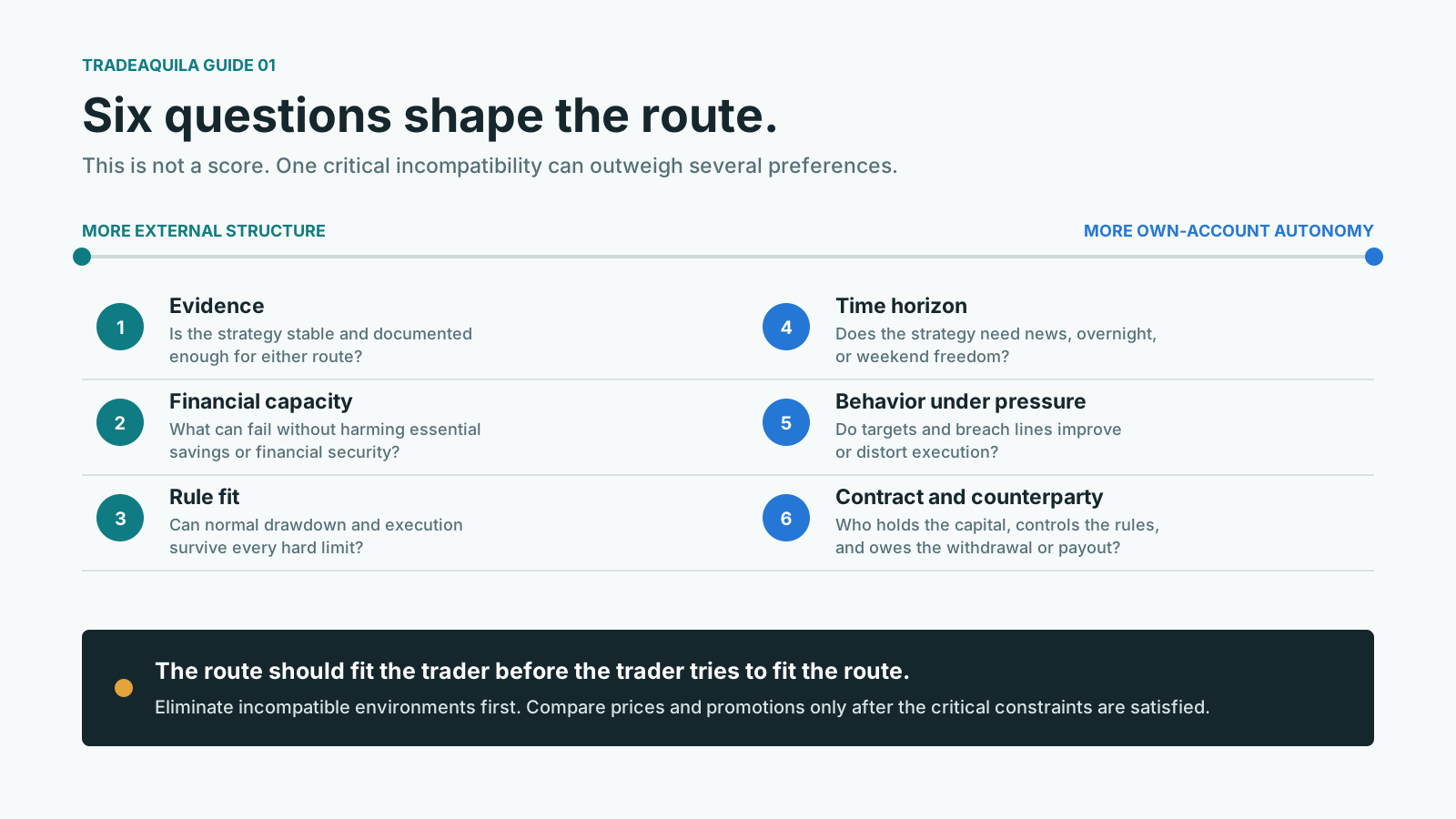
This is not a points quiz. A single critical "no" can decide the result.
- Do I have a stable, documented strategy?
- Do I know its normal drawdown and losing streak?
- Can I afford the complete failure scenario without using essential money?
- Does the strategy fit every important account rule?
- Will a target or hard breach line change how I trade?
- Do I need overnight, weekend, or news-event freedom?
- Do I understand whether the account is simulated or live?
- Do I understand exactly what I can withdraw and when?
- Have I included retries, financing, commissions, data, and platform costs?
- Can I verify the broker or provider's legal entity and current terms?
- What stops me after a bad trade or bad day?
- Which route still works in a difficult month, not only a winning month?
12. The choice is not permanent or necessarily exclusive
Some traders move through several stages:
- Simulation while developing a process
- A very small own-funds account to observe real-money behavior
- A compatible evaluation after building evidence
- A separate own-funds account for strategies that need more freedom
Others use only one route. Some allocate different strategies to different environments.
The important point is to avoid turning the route into an identity. "Prop trader" and "independent trader" are labels. The underlying work remains the same:
- Find a repeatable edge
- Protect capital
- Control exposure
- Execute consistently
- Understand every counterparty
Conclusion
Prop trading and own-funds trading do not offer the same relationship to capital, rules, or risk.
A prop program may offer access to a larger notional environment while limiting initial personal cash exposure. In return, the trader accepts qualification costs, hard constraints, payout conditions, and provider dependency.
An own-funds account offers direct ownership of the account equity and greater control over strategy and withdrawals. In return, the trader's real capital absorbs losses, and self-imposed risk limits must be strong enough to replace the program's external boundaries.
The better route is the one that:
- Preserves the strategy's valid behavior.
- Keeps total losses within what the trader can afford.
- Does not depend on unrealistic performance.
- Remains understandable in a difficult scenario.
- Allows the trader to act consistently rather than emotionally.
Choose the structure only after understanding the trader.
Educational and source note
This guide is general education, not investment, legal, tax, or personalized financial advice. Trading leveraged products can result in rapid and substantial losses. Provider terms, broker protections, regulations, and program structures change. Verify all current information with the relevant provider, broker, regulator, and a qualified professional where appropriate.
Provider examples are included only to explain differences in account structure. They are not endorsements, rankings, or recommendations.
Primary references reviewed on 2026-07-25: