CFD Prop or Futures Prop? How to Choose the Funded Route That Fits
Full guide · 18 min read · last fact-check 2026-07-28
An honest comparison of two funded-trading routes
Two traders can both say they trade the Nasdaq through a prop firm while using very different instruments, prices, platforms, rules, and risk units.
One may trade a provider's US100 contract on MetaTrader. Position size is
expressed in lots, the quote is supplied through the provider's technical
environment, and the trading result may include spread, commission, and
overnight financing.
The other may trade NQ or MNQ futures using exchange market data. Position
size is expressed in contracts, each tick has a standardized value, and the
contract has a defined expiry month.
Both traders may begin in a simulated evaluation. Both may earn real payouts under a contract. Neither necessarily owns the large balance displayed on the screen.
The useful question is therefore not:
Is CFD prop trading better than futures prop trading?
It is:
Which market structure, program contract, risk unit, and operating environment allow my strategy to function without forcing me to trade in a way it was not designed for?
This guide compares the two routes without ranking providers or assuming that one route is more professional, transparent, or profitable for every trader.
Short answer: A CFD-funded program may fit a trader who already works with foreign exchange, rolling indices, metals, flexible lot sizes, or MetaTrader automation. A futures-funded program may fit a trader who values standardized exchange contracts, centralized price discovery, exchange volume, or order-book tools. The funded-program rules can matter more than the instrument label in either case.
1. First, define what is being compared
The expression prop firm is used loosely online. It can describe a traditional proprietary trading company, a retail evaluation service, a simulated funded program, or a program with a possible path to live firm capital.
This article compares two common retail routes:
CFD-style funded programs
The trader normally pays for an evaluation or program account and trades foreign exchange, indices, commodities, metals, shares, or crypto through rolling contracts offered in a retail-style platform environment.
These products are often described collectively as CFDs, although the exact legal and technical arrangement depends on the provider and jurisdiction. Many evaluation firms are not brokers and do not accept a client deposit for a normal brokerage account.
For example, FTMO states that its Challenge, Verification, and FTMO Accounts use fictitious capital. Its traders receive real rewards calculated from simulated results, while FTMO may use client trading data separately when trading its own capital. FTMO technical explanation
Futures-funded programs
The trader normally pays for an evaluation and trades simulated futures using prices linked to exchange-traded contracts. Common markets include equity indices, energy, metals, interest rates, agriculture, and currency futures.
Passing an evaluation may lead to another simulated account with payout eligibility, a live funded account, or a provider-specific progression model.
For example, Topstep describes its Trading Combine as simulated, its Express Funded Account as a simulated funded-level account with real payout eligibility, and its Live Funded Account as a separate later stage using firm capital. Topstep program overview, Express Funded Account parameters
These examples explain two current structures. They do not define every CFD or futures program.
The word "funded" does not answer three essential questions
Before comparing either route, ask:
- Is the account simulated or live?
- Can the trader receive real payouts from simulated performance?
- Is there a documented path to a live firm-capital account, and is that path available in the trader's jurisdiction?
A simulated account can produce a real contractual payout. A live account can still impose strict provider controls. The label alone does not explain the relationship.
2. The central difference: OTC-style pricing versus exchange contracts
CFD market structure
A contract for difference is an over-the-counter derivative. It allows a trader to speculate on a price movement without owning the underlying asset.
In an ordinary retail CFD account, the CFD provider manufactures the contract and supplies the tradable bid and ask. The UK's Financial Conduct Authority describes CFD providers as manufacturers of OTC derivatives and identifies spread, commission, and overnight funding as material parts of the price paid by a customer. FCA CFD price and value review
In a simulated CFD-funded program, the trader may not enter a legal CFD transaction at all. The program can instead simulate the result using market quotes and its own contract specifications. The trader must understand both the reference market and the provider's simulated instrument.
Futures market structure
A futures contract is a standardized agreement created by an exchange. The exchange defines the contract quantity, tick size, expiry, settlement terms, and other specifications.
Live exchange-traded futures are centrally cleared. The clearing house becomes the buyer to every seller and the seller to every buyer, reducing the direct credit exposure between the original counterparties. CFTC explanation of futures markets, CME definition of a futures contract
That market structure does not automatically make a retail futures evaluation account live or exchange-cleared. A simulated program can use real exchange data without sending the trader's order to the exchange.
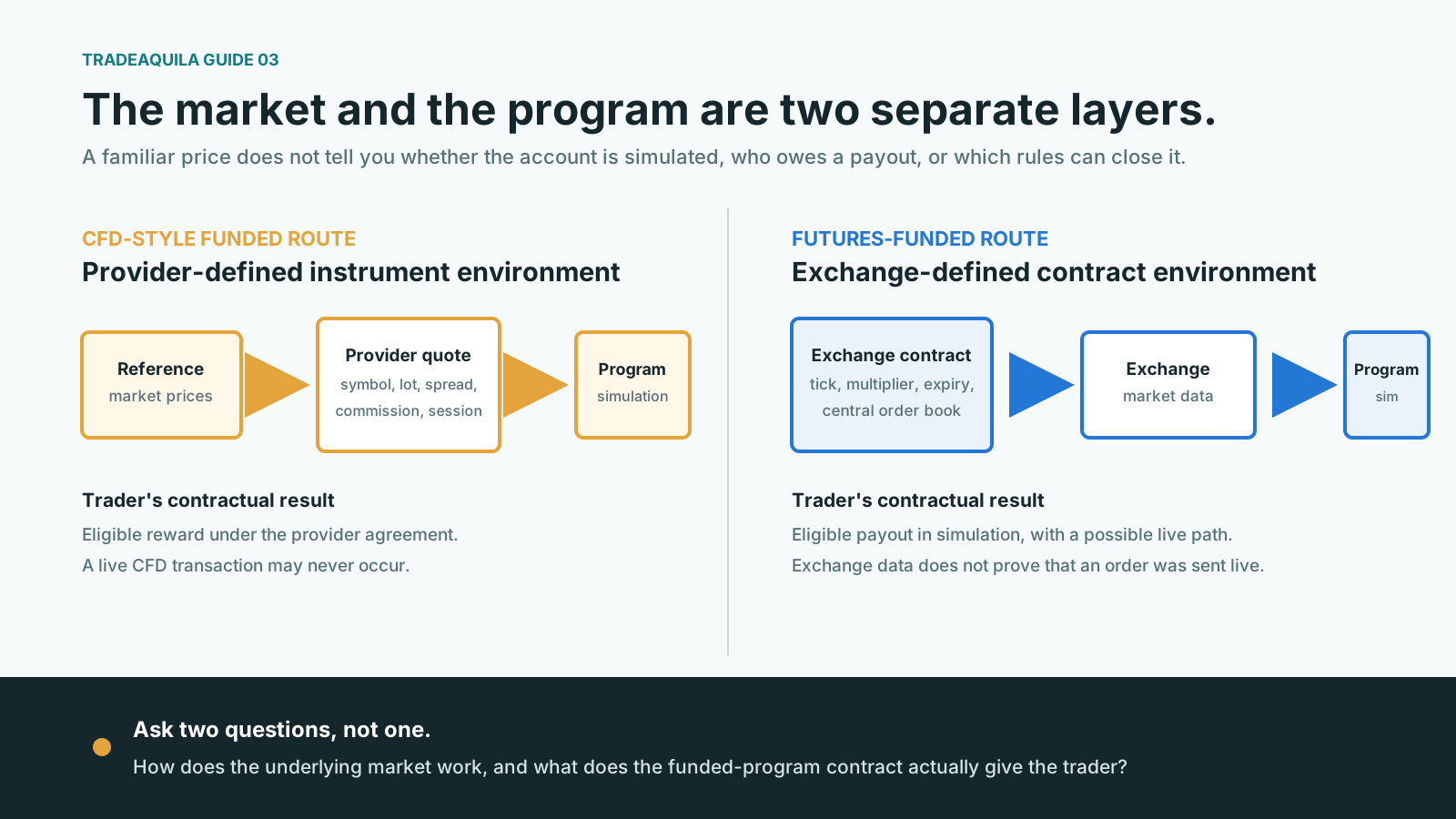
The protection does not automatically travel through the simulation
This distinction is easily missed.
- A regulated CFD broker may owe duties to its retail brokerage clients.
- A regulated futures exchange and futures commission merchant operate inside a defined market and customer-protection framework.
- A retail evaluation company may instead provide a simulated service under a separate commercial contract.
The regulation of the underlying market does not by itself guarantee a payout from an evaluation company, protect an evaluation fee, or determine how a simulated trade dispute will be resolved.
Always identify the legal entity that sells the program, the entity that owes the payout, the law governing the contract, and the protections that actually apply to that relationship.
3. The practical difference in one table
| Question | CFD-style funded program | Futures-funded program |
|---|---|---|
| What is referenced? | Provider-defined rolling contracts on currencies, indices, commodities, metals, shares, or crypto | Standardized futures contracts listed by an exchange |
| How is size expressed? | Lots, units, or volume defined in the symbol specification | Whole contracts, including smaller Micro contracts where available |
| How is the minimum price movement defined? | Provider symbol specification; can differ between environments | Exchange-defined tick size and tick value |
| Where does the visible price come from? | Provider or technical partner quote derived from one or more reference markets | Exchange market data, although a simulated fill engine may still determine the account result |
| Is there one central order book? | Normally no single CFD order book shared by all providers | The live futures contract has a central exchange order book |
| Can the trader see exchange volume and depth? | Usually not for the CFD itself; platform volume may be tick volume or provider-specific | Exchange volume and Level 1 or Level 2 depth may be available, subject to data rights and program support |
| Does the contract expire? | Rolling CFDs normally do not expire, although financing and provider adjustments can apply | Futures expire and must be closed, settled, or rolled; funded programs may automate or restrict this |
| What are common trading costs? | Spread, commission, swap or overnight financing, and slippage | Commission, exchange and clearing fees, data, platform charges, and slippage |
| What program costs may apply? | Evaluation fee, reset, activation, add-ons, or recurring access | Subscription, reset, activation, data upgrade, platform, or recurring access |
| What platforms are common? | MetaTrader, cTrader, and other retail CFD platforms | Futures-specific web, desktop, chart, DOM, and API platforms |
| How granular is position sizing? | Often relatively fine because fractional lots may be available | Discrete contracts; Micro contracts reduce but do not eliminate size steps |
| Are overnight positions possible? | Depends on account type and provider rules; financing may apply | The exchange may trade nearly 23 hours, but many funded programs still require daily flattening |
| Is a live funded stage guaranteed? | No; some programs remain simulated at every stage | No; some include a possible live path, others remain simulated |
| What commonly ends the account? | Daily or total loss breach, prohibited practice, or contract termination | Maximum-loss breach, position-limit breach, session violation, prohibited practice, or contract termination |
| Which route is easier? | Neither; familiarity can reduce platform friction but not trading risk | Neither; standardized contracts do not make the evaluation easier |
The table describes common patterns, not universal rules. A provider can change the pattern through its contract.
4. The displayed account size is not comparable
A $100,000 CFD prop account and a $100,000 futures prop account should not
be treated as equivalent capital.
In either route, the displayed number may primarily determine:
- Maximum position size
- Profit target
- Daily loss amount
- Total or trailing loss amount
- Program price
- Payout tier
It may not represent cash deposited into an account for the trader.
Hypothetical CFD-funded example
Suppose a program displays $100,000 and applies:
- A
$5,000daily-loss limit - A
$10,000maximum-loss limit - A
$450evaluation fee - A profit target
- Spread, commission, and overnight adjustments in the simulated result
The strategy does not have $100,000 of loss capacity. It must survive inside
the provider's daily and total limits.
Hypothetical futures-funded example
Suppose a program displays $100,000 and applies:
- A
$3,000trailing maximum-loss amount - A maximum of ten standard contracts or one hundred Micro contracts
- A monthly evaluation subscription
- A consistency objective
- A requirement to close every position before the provider's daily cutoff
Again, the headline balance is not the usable risk budget. The binding constraint may be the trailing loss line, the contract limit, or the daily session rule.
These figures are illustrations, not offers from a named provider.
Compare four operational numbers
- Loss capacity: the amount and formula that can terminate the account.
- Smallest practical risk unit: the loss from the smallest useful position at the strategy's normal stop distance.
- Normal strategy drawdown: including intraday open-equity behavior.
- Personal cash exposure: fees, resets, activation, data, and other non-refundable costs.
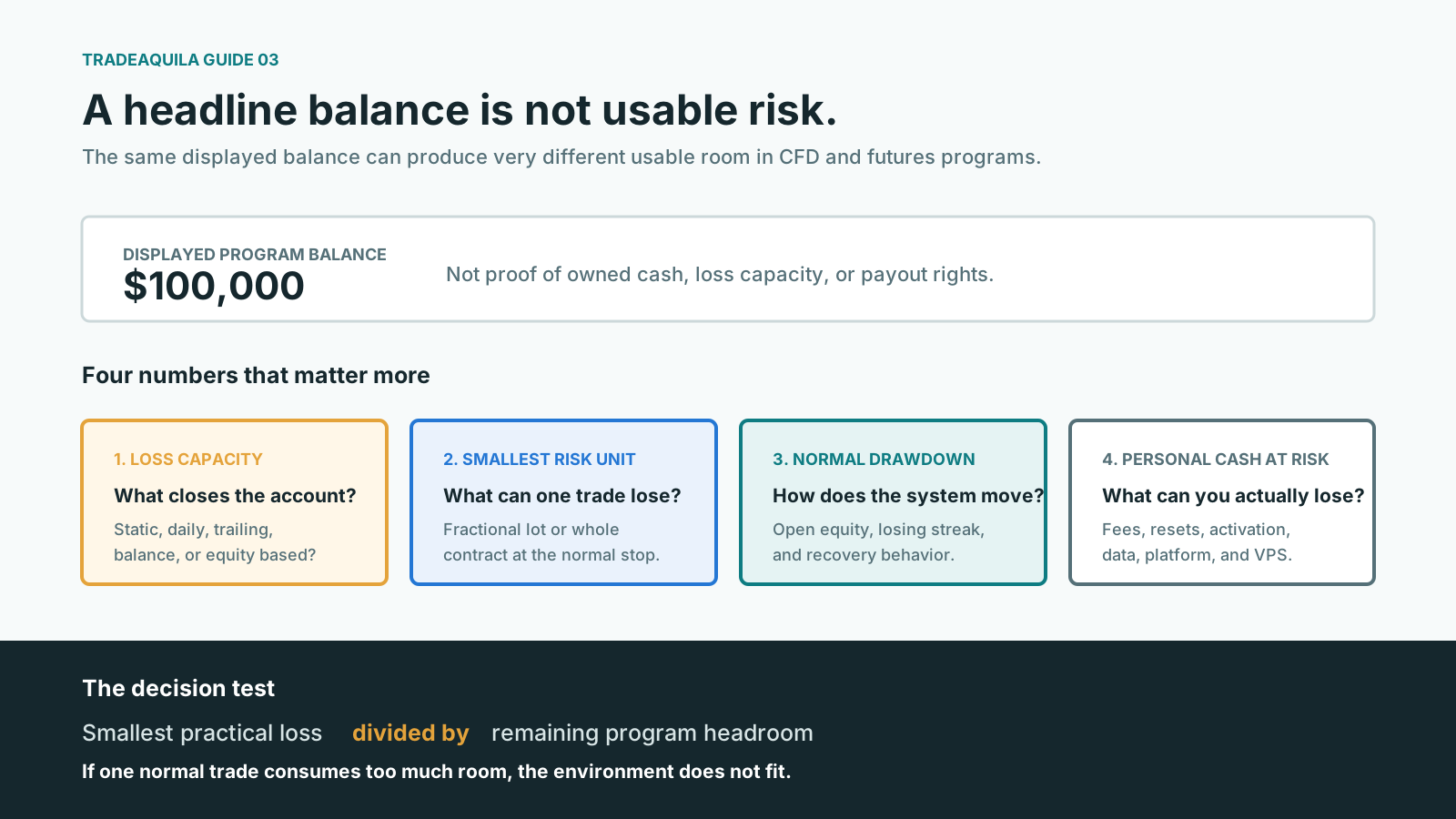
The route with the larger displayed balance can still leave less room for a particular strategy.
5. Position sizing: flexibility versus standardization
CFD position sizing
CFD platforms often allow volume to be adjusted in fractions of a lot. This can help a trader align position risk with:
- Stop distance
- Instrument volatility
- Percentage risk
- Currency conversion
- Account headroom
The flexibility is useful only when the trader understands the symbol specification. One lot of an index CFD can represent a different point value at another provider. Symbol names that look similar do not prove identical contract sizes.
Before trading, verify:
- Contract size
- Tick size
- Tick value
- Minimum and maximum volume
- Volume step
- Profit currency
- Margin currency
- Commission
- Trading hours
- Swap or overnight treatment
Futures position sizing
Futures contracts have standardized multipliers and ticks. For example, CME
Group states that Micro E-mini equity-index futures are one tenth the size of
their related E-mini contracts. MES uses a $5 multiplier and a $1.25
minimum tick value, while MNQ uses a $2 multiplier and a $0.50 minimum
tick value. CME Micro E-mini
overview
This makes the risk calculation explicit:
Contracts x stop distance in ticks x value per tick
The disadvantage is indivisibility. A trader cannot normally trade 0.35 of a
futures contract. A Micro contract provides a smaller step, but it can still be
too large for a tight drawdown limit, a wide stop, or a volatile product.
The useful test
Calculate the smallest position at the strategy's normal stop:
Smallest-position loss / remaining program headroom
If the smallest practical trade consumes too much of the available headroom, the route does not fit even when the instrument itself is attractive.
6. Price, liquidity, fills, and simulation
What CFD traders see
CFD providers can use different liquidity sources, markups, contract specifications, session definitions, and execution policies. Two providers can show slightly different spreads or prices for instruments carrying similar names.
This does not mean that every CFD quote is unfair. It means the trader should test the actual environment rather than assuming that a chart symbol is universal.
Important questions include:
- Is the spread fixed or variable?
- What happens around rollover and low-liquidity periods?
- How are stops and gaps handled?
- Which prices trigger daily or maximum-loss rules?
- Does the program count open P&L, commission, and swaps?
- What evidence is available if a price or fill is disputed?
The CFTC makes a related distinction for retail OTC foreign exchange: an electronic retail forex platform connects the customer to the dealer rather than to an open exchange. CFTC retail forex advisory
What futures traders see
A live futures contract has one exchange-defined contract and centralized price discovery. Traders may have access to:
- Best bid and ask
- Time and sales
- Traded volume
- Market depth
- Open interest
- Exchange settlement prices
Those features can be valuable for volume, order-flow, and DOM-based strategies.
But a simulated futures evaluation still needs a fill model. The simulator must decide whether a limit order would have filled, what queue position to assume, and what slippage to apply.
Topstep's current prohibited-strategy documentation, for example, explicitly warns against exploiting unrealistic simulated fills, queue behavior, or an assumed lack of slippage. Topstep prohibited trading strategies
Exchange data is an advantage, not a promise about simulation
Exchange data can make the reference price and traded volume more observable. It does not guarantee that:
- Every simulated order would have filled live.
- The payout company cannot reject prohibited behavior.
- Latency is identical across platforms.
- A strategy can be scaled without market impact.
- A simulated account will progress to live capital.
Evaluate the data source and the simulation policy separately.
7. Costs: compare the complete path
The cheapest entry price is rarely the complete cost.
Possible CFD-funded costs
- Evaluation or instant-access fee
- Reset or retry fee
- Activation or account fee
- Spread
- Commission
- Overnight financing or swap
- Currency conversion
- Platform or data add-ons
- VPS or automation infrastructure
- Provider share of eligible rewards
For a swing strategy, overnight costs can materially change the result. For a high-frequency strategy, spread and commission can matter more.
Possible futures-funded costs
- Monthly evaluation subscription
- Reset fee
- Activation fee
- Commission
- Exchange and clearing fees
- Regulatory fees where applicable
- Market-data subscription or depth upgrade
- Platform or API charge
- VPS or automation infrastructure
- Provider share of eligible payouts
Some programs include basic exchange data and charge for deeper market data. Topstep, for example, currently states that Level 1 data is included for its Trading Combine and Express Funded Account, while Level 2 depth is a paid upgrade. Topstep market-data explanation
Build a twelve-month path-cost model
Estimate at least three scenarios:
- Pass on the first attempt.
- Require several months or resets.
- Never reach a payout.
Include the strategy's expected trading costs, not only the provider invoice. Then compare:
Total personal cash paid / realistic eligible payout opportunity
Do not use an advertised account balance as the denominator.
8. Drawdown rules often decide the answer
The market label does not determine the drawdown model.
A trader can find:
- Static maximum loss
- Balance-based loss
- Equity-based loss
- Intraday trailing loss
- End-of-day trailing loss
- Daily loss reset at a specified time
- Consistency targets
- Minimum trading days
- Position or contract limits
Common CFD-style pattern
Many CFD-style evaluations use a daily loss line and a maximum loss line. Open P&L, closed P&L, commission, and swaps may all enter the calculation.
FTMO's current objectives illustrate how provider formulas can differ even inside one company: its two-step product uses a static maximum-loss calculation, while its one-step product uses an end-of-day trailing maximum-loss limit. Its daily reset is tied to midnight Central European time. FTMO trading objectives
This is an example, not a rule for all CFD programs.
Common futures-style pattern
Many futures evaluations emphasize a maximum-loss amount that can trail the account, a maximum contract size, and a session cutoff. Consistency conditions are also common.
Topstep's current Trading Combine, for example, describes a maximum-loss rule, a profit target, a consistency objective, and contract-size limits. Its permitted-product page requires positions to be closed by a provider-defined weekday cutoff even though many CME products trade for a much longer exchange session. Topstep Trading Combine parameters, permitted products and hours
Again, this does not define every futures program.
Translate the rule into your strategy's behavior
Do not ask only:
How large is the loss limit?
Ask:
- Does it trail open equity or closed balance?
- When does it move?
- Can it move downward again?
- Does a payout reduce the remaining buffer?
- Which time zone defines the day?
- Can open positions cross that reset?
- Does the strategy normally experience open drawdown before recovery?
- Can one normal trade consume too much of the limit?
A wider percentage can be less usable than a smaller static amount if the trailing formula conflicts with the strategy.
9. Trading hours, holding period, and contract expiry
CFD-style programs
Rolling currency and index contracts generally avoid a quarterly contract roll, but the provider defines its trading week, daily breaks, holiday hours, and rollover treatment.
Overnight and weekend permission varies. FTMO, for example, currently distinguishes its Standard and Swing account types, with different holding permissions at the funded-account stage. FTMO overnight and weekend rules
Permission to hold does not remove:
- Gap risk
- Financing costs
- Weekend risk
- Daily-loss reset interactions
- Provider-specific news rules
Futures-funded programs
Many major futures contracts trade nearly 23 hours on weekdays, but a funded program can require traders to flatten before its own cutoff. A program can therefore be operationally intraday even when the exchange contract supports a longer session.
Futures contracts also expire. The trader or platform must move from one contract month to another. CME Group explains that a trader approaching expiration can close, settle, or roll a position, depending on the contract and strategy. CME expiration guide
For a short-term day trader, expiry management may be a routine platform task. For a swing system, continuous-contract research and live contract selection can require additional care.
Holding period is a hard filter
- A strategy designed to hold for several days does not fit a mandatory daily close.
- A strategy that relies on avoiding overnight financing may prefer an intraday structure.
- A system trained on continuous futures data must still know which contract it will actually trade.
- A system trained on one CFD feed should not assume identical behavior at another provider.
10. Platform, automation, and infrastructure
Why CFD-style programs may feel familiar
CFD programs often use platforms already familiar to foreign-exchange and retail algorithmic traders. FTMO currently supports MetaTrader 4, MetaTrader 5, and cTrader, and states that legitimate algorithmic strategies and Expert Advisors are permitted subject to its rules and technical limits. FTMO platforms, FTMO strategy rules
Potential advantages include:
- Existing indicators or EAs
- Fine lot-size control
- Familiar backtesting workflow
- Broad instrument access in one terminal
- Mature VPS ecosystem
Potential constraints include:
- Provider-specific symbols
- Different feeds and spreads
- Server message and order-frequency limits
- Restrictions on copied or widely shared strategies
- Dependence on the platform-provider environment
Why futures programs may appeal to specialist traders
Futures platforms can provide:
- DOM or ladder trading
- Exchange volume
- Time and sales
- Contract-specific order flow
- Bracket and advanced order tools
- APIs and trade-copying tools where supported
Potential constraints include:
- Whole-contract sizing
- Data agreements
- Platform-specific automation languages or APIs
- Contract roll handling
- Provider restrictions on copying, latency, or simulated-fill exploitation
- Different functionality between evaluation, simulated funded, and live stages
Automation permission is not enough. The trader must verify:
- Whether the exact strategy is allowed.
- Whether the platform supports every required order type.
- Whether the system can monitor the provider's drawdown in real time.
- What happens if the terminal, VPS, API, or provider connection fails.
- Whether identical trades across accounts violate copying or allocation rules.
11. The honest pros and cons
CFD-funded route: potential advantages
- Fine position-size increments on many instruments.
- Familiar environment for MetaTrader, cTrader, forex, and EA users.
- Broad access to currencies, indices, metals, commodities, shares, or crypto, depending on the provider.
- Rolling instruments can remove the need for a quarterly futures roll.
- Some programs offer account types designed for overnight or swing trading.
- One platform can cover several asset classes.
CFD-funded route: potential disadvantages
- No universal CFD price or contract specification across providers.
- Spread and overnight financing can be material.
- Provider feeds, symbol values, and session times can differ.
- Exchange volume and central order-book depth are normally unavailable for the CFD itself.
- Jurisdiction and consumer-protection arrangements vary significantly.
- A simulated account may have no documented path to live capital.
Futures-funded route: potential advantages
- Standardized contract, tick, and expiry specifications.
- Centralized exchange price discovery for the underlying futures contract.
- Access to exchange volume, time and sales, and depth where supported.
- Micro contracts provide smaller risk steps for many popular markets.
- Trading costs are often explicit per contract.
- Some programs document a progression from simulated evaluation to simulated payout account and potentially to live firm capital.
Futures-funded route: potential disadvantages
- Position size remains discrete, even with Micro contracts.
- A single tick or normal stop can still be large relative to program headroom.
- Contract expiry and roll must be understood.
- Market data, depth, platform, and API charges may apply.
- Mandatory daily flattening is common in some programs.
- Trailing loss and consistency rules can conflict with otherwise valid strategies.
- Simulated fills can differ from live queue position and slippage.
- A possible live pathway is not the same as guaranteed live funding.
Neither list predicts profitability.
12. When a CFD-funded route may fit
A CFD-funded route may be worth investigating when several of the following are true:
Your edge was developed on the same type of instrument
Your evidence comes from the same CFD or retail FX structure, with realistic spread, commission, swap, session, and slippage assumptions.
You need fine position sizing
The ability to adjust fractional lots allows the normal stop distance to fit inside the program's daily and total loss limits.
Your workflow depends on MetaTrader, cTrader, or an EA
Moving to a different platform or contract model would require a material strategy rewrite or introduce untested execution behavior.
You trade markets not available in the futures program
The provider offers the particular currency pair, share, index, crypto instrument, or contract structure the strategy requires.
You have verified the feed and cost behavior
The strategy remains viable under the actual symbol specification, spread, commission, swap, and session rules.
13. When a futures-funded route may fit
A futures-funded route may be worth investigating when several different conditions are true:
Your strategy uses exchange information
The edge depends on exchange volume, DOM, time and sales, order flow, or a specific standardized futures contract.
The contract's tick risk fits the loss limit
The smallest suitable contract and normal stop leave enough headroom for losing streaks and intraday variation.
You operate primarily intraday
The strategy naturally exits before the program cutoff and does not need weekend or multi-day holds.
You accept expiry and rollover work
Your data, backtest, indicators, and execution logic handle the active contract and its transition correctly.
A documented live path matters to you
You have verified that the provider actually offers a live funded stage, that selection is not automatic, and that your jurisdiction is eligible.
14. Five traders, five possible conclusions
These examples are hypothetical.
Yasmine: the EURUSD EA operator
Yasmine has a five-year MT5 strategy with spread filters, a VPS, fractional lot sizing, and no dependency on exchange order flow.
A CFD-funded route may require less adaptation. But she still needs to test the provider's symbol, spread, server time, EA rules, order-frequency limits, and drawdown calculation.
Futures FX could be a valid alternative, but it would be a new contract, quotation, sizing, data, and execution environment. It should be researched and validated rather than treated as a direct replacement.
Adam: the Nasdaq order-flow scalper
Adam makes decisions from traded volume, time and sales, and the order book. He closes every position during the main U.S. session.
A futures-funded route may fit the information his strategy uses. He must still model commission, tick risk, simulated queue behavior, contract limits, and the program's loss rule.
A Nasdaq CFD chart may show a similar direction while lacking the exact order flow on which his edge depends.
Nora: the multi-day index swing trader
Nora holds positions for two to four days and uses wide volatility-based stops.
A futures program requiring daily flattening is incompatible. A CFD program with a swing account may be operationally possible, but overnight financing, weekend gaps, and daily-loss resets need to be measured.
Another futures provider with overnight permission could also be viable. The instrument name alone does not decide the route.
Leo: the beginner attracted by account size
Leo has no stable strategy record and wants the largest advertised account for the lowest fee.
Neither route is yet a good fit. CFD flexibility cannot create an edge, and futures standardization cannot replace risk experience. Leo should first learn the instrument, build a sample, and measure a repeatable process.
Priya: the systematic index trader
Priya has separate research for an index CFD and Micro E-mini futures. Both systems are viable, but their execution assumptions are different.
She may choose the route whose smallest risk unit, costs, loss formula, automation interface, and session rules leave the greatest margin for normal variation. She may also keep the two systems separate rather than forcing one model across both environments.
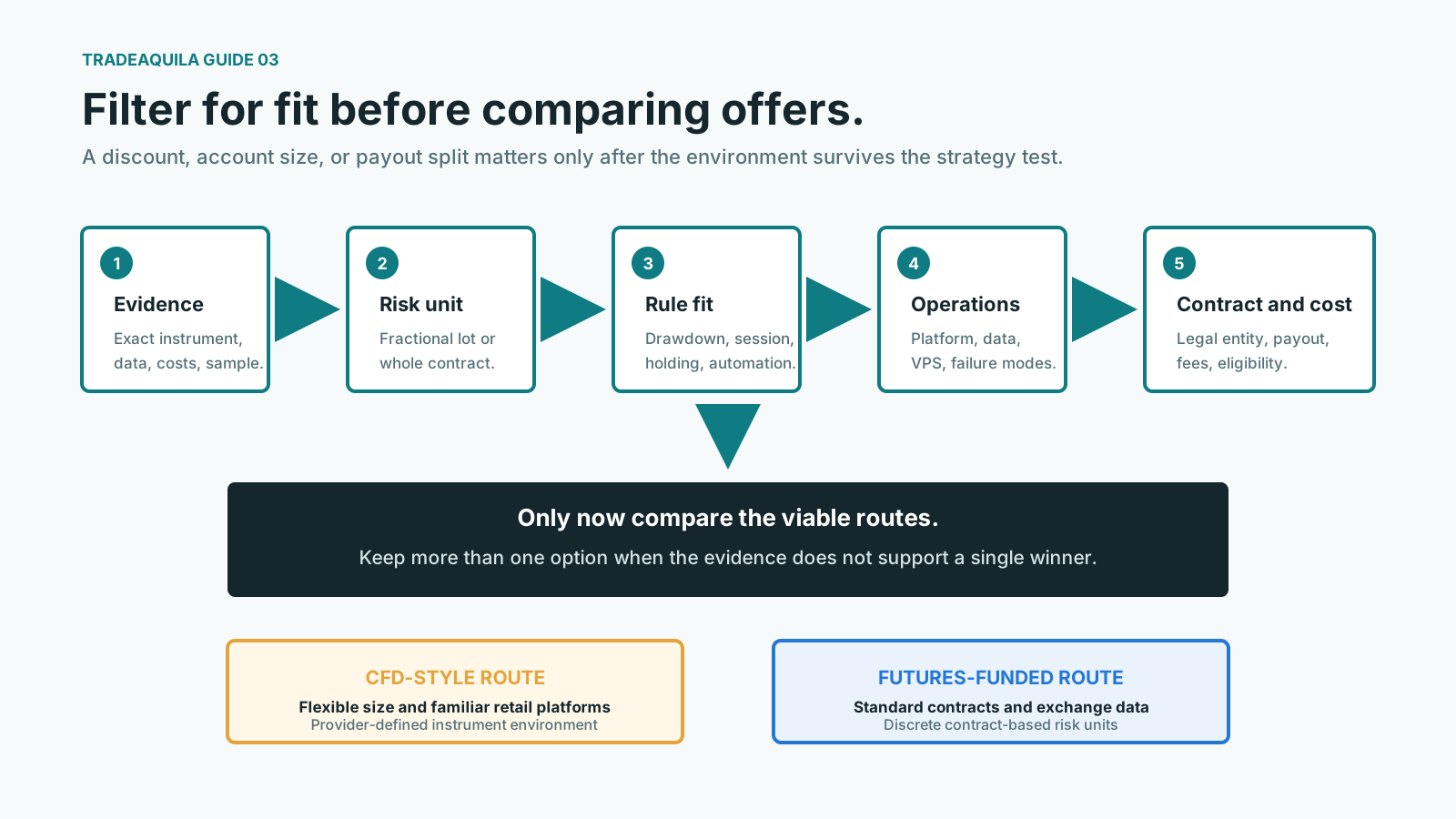
15. A neutral seven-step decision process
Step 1: Identify the strategy's true instrument
Write down the exact symbol, contract, price source, time zone, session, and holding period used in the evidence.
Do not write only gold, Nasdaq, or EURUSD.
Step 2: Calculate the smallest useful risk unit
For CFDs:
Lot size x value per point or pip x normal stop distance
For futures:
Contracts x tick value x normal stop distance in ticks
Include commission and realistic slippage.
Step 3: Rebuild the program's loss formula
Calculate the loss line yourself for:
- Start of day
- Open profit followed by reversal
- Open loss at the daily reset
- New equity high
- Payout withdrawal
- Losing streak
If the formula cannot be reproduced, do not buy the evaluation.
Step 4: Eliminate incompatible rules
Remove programs that conflict with:
- Holding period
- News behavior
- Automation
- Position size
- Trading frequency
- Instrument availability
- Jurisdiction
- Payout method
Do this before comparing discounts or profit splits.
Step 5: Compare complete costs
Use a twelve-month model with evaluation, resets, activation, data, platform, spread, commission, financing, VPS, and payout share.
Step 6: Investigate the provider contract
Verify:
- Legal entity
- Simulated and live stages
- Payout obligation
- Rule-change policy
- Dispute process
- Prohibited practices
- Data and privacy terms
- Jurisdiction eligibility
- Termination rights
Step 7: Use the smallest useful trial
Test the platform and rules before scaling the number or size of accounts.
The purpose is to discover operational mismatch at low personal cost.
16. Provider due-diligence checklist
Before paying for either route, obtain clear answers to these questions.
Account and legal relationship
- Which legal entity sells the evaluation?
- Is each stage simulated or live?
- Which entity owes an eligible payout?
- Is there a possible live stage?
- Is that stage available in your country?
Rules
- Is drawdown static, trailing, balance-based, or equity-based?
- Which time zone defines a trading day?
- Do open P&L, commission, spread, swaps, and fees count?
- What changes after a payout?
- Are news, overnight, weekend, copying, and automation allowed?
Market and platform
- What is the price source?
- What are the contract and symbol specifications?
- How are simulated fills and slippage calculated?
- Which market data is included?
- What happens during an outage or bad-price dispute?
Economics
- Which fees are one-time and which recur?
- Is activation required?
- What are the payout conditions, caps, and review rights?
- Can rules or prices change after purchase?
- What happens to unpaid simulated profit when an account closes?
Screenshots of a marketing table are not a substitute for the current terms.
17. Self-assessment
Answer each question before comparing providers.
- Which exact instrument produced my strategy evidence?
- Does the strategy require exchange volume or order-book data?
- What is the normal stop distance?
- What is the smallest practical loss per trade in each route?
- What is the worst observed intraday open drawdown?
- How long does the strategy hold?
- Does it hold through daily reset, rollover, news, or weekends?
- Does it depend on fractional lot sizing?
- Does it depend on MetaTrader, cTrader, a specific futures platform, or an API?
- Can it handle contract expiration and rollover?
- What complete costs apply over twelve months?
- Can I afford every fee without needing a payout?
- Do I understand who owes the payout?
- Have I tested the actual platform and rule calculations?
If several answers are unknown, the next step is research or simulation, not a purchase.
18. The route can change
A trader does not need to choose one structure forever.
Possible paths include:
- Begin with one CFD program while an existing MT5 system is validated.
- Move an intraday index strategy to Micro futures after new research.
- Use a futures program for order-flow trading and a separate CFD environment for currencies.
- Stop funded evaluations and trade personal capital.
- Use neither route while rebuilding the strategy.
Each strategy should earn its place in each environment. A result from one instrument, feed, or program should not be assumed to transfer unchanged.
Conclusion
CFD-funded and futures-funded programs solve a similar commercial problem: they allow a trader to demonstrate performance under defined rules without beginning by depositing the full advertised account balance.
They solve it through different operating environments.
The CFD route commonly offers flexible sizing, broad retail instruments, and familiar MetaTrader or cTrader workflows. Its prices, contract specifications, spreads, and financing remain provider-dependent.
The futures route offers standardized exchange contracts, centralized price discovery, exchange volume, and explicit tick values. It also introduces whole contract sizing, data and platform requirements, expiration, and often strict session or trailing-loss rules.
Neither structure is universally better.
The stronger route is the one where:
- The strategy was tested on the right instrument and data.
- The smallest risk unit fits comfortably inside the loss rules.
- The holding period and execution method are permitted.
- The complete costs are affordable.
- The simulated and live stages are understood.
- The provider's contract remains acceptable even if no payout is ever earned.
Choose the environment only after translating its rules into the actual behavior of your strategy.
TradeAquila principle: Compare the market structure, program contract, risk unit, and complete operating environment before comparing the headline account size.
Educational and source note
This article is educational and does not provide investment, legal, tax, or provider-specific advice. CFD and futures trading are leveraged and can produce rapid losses. Evaluation fees can be lost even when the displayed account is simulated.
Provider rules, products, jurisdictions, and payout terms change frequently. The examples were checked on 2026-07-28 — verify the current terms yourself before any purchase.
Primary sources consulted:
- CFTC: The economic purpose and structure of futures markets
- CFTC: Futures market basics
- CFTC: Retail OTC forex advisory
- FCA: Contract for differences overview
- FCA: CFD price and value review
- CME Group: Definition of a futures contract
- CME Group: Micro E-mini overview
- CME Group: Managing futures expiration
- FTMO: Technical account structure
- FTMO: Trading objectives
- FTMO: Platforms and instruments
- Topstep: Program overview
- Topstep: Trading Combine parameters
- Topstep: Products and trading hours
- Topstep: Market-data levels
At the time of fact-check (see date above), TradeAquila had no commercial relationship with the providers cited as examples in this article. A future relationship would not change the editorial analysis or organic suitability logic.